Route Summarization Calculator
Plan CIDR aggregates for home labs, branch networks, OSPF areas, VPN route tables, and BGP announcements with route savings, unused address space, and platform headroom.
Calculation Breakdown
| Specific Routes | Child Prefix | Clean Summary | Use Case |
|---|---|---|---|
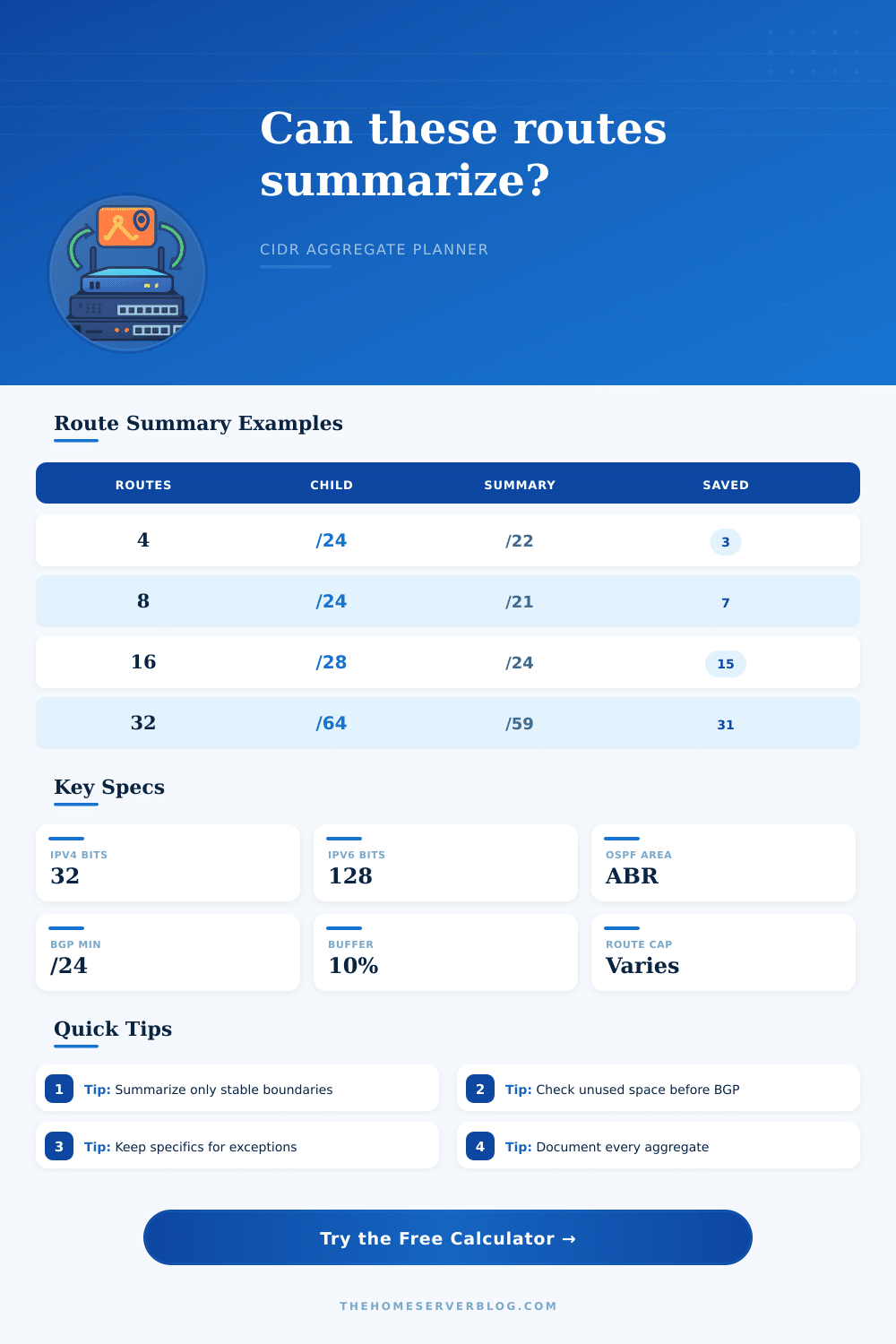
| 2 contiguous routes | /24 IPv4 | /23 | Pair of VLANs or adjacent branch LANs |
| 4 contiguous routes | /24 IPv4 | /22 | Small site block with room naming by floor |
| 8 contiguous routes | /24 IPv4 | /21 | Campus zone or multi-building home lab |
| 16 contiguous routes | /28 IPv4 | /24 | Service, DMZ, or point-to-point loopback pool |
| 32 contiguous routes | /64 IPv6 | /59 | IPv6 lab with many LAN segments |
| Summary Prefix | /24 IPv4 Routes | /28 IPv4 Routes | /64 IPv6 Routes |
|---|---|---|---|
| /30 | Not practical | 1/4 of a /28 | Not used |
| /24 | 1 | 16 | Not used |
| /22 | 4 | 64 | Not used |
| /20 | 16 | 256 | Not used |
| /56 IPv6 | Not used | Not used | 256 |
| Profile | Planning Limit | Good Fit | Summary Caution |
|---|---|---|---|
| Home router / small firewall | 2,000 routes | Default plus lab routes | Keep local summaries simple and reversible. |
| OPNsense or pfSense appliance | 8,000 routes | Home lab, VLANs, VPNs | Document static discard routes for wide aggregates. |
| MikroTik home lab router | 16,000 routes | BGP lab, routed VLAN core | Watch memory and fast-path behavior on small models. |
| Cloud route table | 200 routes | VPC, VPN, transit gateway | Summaries often matter more than raw address waste. |
| ISP or enterprise edge | 900,000 routes | Full table or customer edge | Respect upstream prefix filters and ROA policy. |
| Protocol | Typical Boundary | What to Check | Operational Note |
|---|---|---|---|
| Static routing | Core or firewall | Next hop reachability | Add a discard route when the summary includes unused addresses. |
| OSPF | Area border router | Area range and metric | Do not hide unstable links that need visibility during failure. |
| EIGRP | Interface summary | Administrative distance | Specific routes still override the aggregate by longest match. |
| BGP | Edge or route reflector | Prefix filters and ROA | Public IPv4 announcements are commonly filtered beyond /24. |
| VPN or SD-WAN | Hub, tunnel, or policy | Overlap with remote sites | Summaries reduce control-plane load but can mask overlaps. |
Route summarization is a process that can be performed on an network. Route summarization becomes necessary when a network contains many VLAN. As a network grows, the size of the routing table grow, which uses more memory and CPU power from the device to manage the routing table, and it also takes longer to troubleshoot the routing table.
Route summarization allow an administrator to collapse many route into one route. Route summarization allows networks to reduce number of entries in the routing table. The route summarization calculator is an effective tool for network engineer to test the impact of route summarization on a network prior to implementing route summarization on the network.
Route Summarization and the Calculator
The calculator requires the administrator to input the container prefix, the size of the routes that will be replaced, the total number of routes that exist on the network, a safety buffer for growth in the number of routes, and a hard limit on the size of the summary route. The safety buffer allow for a branch office with a stable number of device to allow for the addition of more device to that branch office in the future. The route summarization calculator returns information to the administrator that includes the number of specific routes that will be removed from the routing table, the amount of unused address space that will exist within the summary route prefix, and the load that the specific hardware platform will experience with the implementation of the route summarization.
These three piece of information can help an administrator to make a decision regarding whether the benefit of reducing the size of the routing table is worth the cost of using address space that could otherwise be used for other devices on the network. Summarizing routes that exist on awkward boundaries in the network may result in more unused address space then routes that are summarized that are otherwise on even boundaries. Knowing the percentage of address space that will be unused will allow an administrator to make sure that they do not make any mistakes during the implementation of the route summarization.
Route summarization can be performed within different routing protocols. In the case of OSPF, the area border router can advertise the summary route. However, if the router advertises the summary route, the status of the individual link behind the router will no longer be visible to the rest of the network.
In the case of BGP, the upstream provider often do not allow routes to be advertised that are of a length greater than a /24 prefix. In this case, the administrator must decide whether to advertise a longer route to remain within policy with the upstream provider, or advertise the specific routes that are required by the network and allow the routing table to become larger. The limits of the hardware platform can impact the use of route summarization.
Small firewalls, for instance, can only support a certain number of routes in their routing tables before the performance of the firewall begins to degrade. Additionally, cloud providers may have a maximum limit to the number of routes in a cloud route table. The profile selector in the route summarization calculator allow an administrator to select the maximum number of routes for the device that will be advertising the route summaries.
If a route summary is created with the calculator that would cause the device to reach the limits of that device’s routing table, the device may begin to experience routing table bloat. Many network engineers make the mistake of implementing route summarization only once on the network. However, services are added and removed from networks over the lifetime of that network.
As a result of these changes, a route summary that was created to meet the needs of the network in the past may not meet the needs of that network in the future. Exception routes can be used to allow for the addition of device to specific networks without having to change the summary route for the network. Additionally, the route summarization calculator can be used to determine in advance how many exception routes will be needed.
Using one or two specific routes for failover pairs will not have a significant impact on the savings that would otherwise be achieved through route summarization. However, these exception routes will provide protection to the network should the longest-match route be required. Documentation is required for any route summaries that are created on a network.
A note is required to be created with each route summary that lists the child prefixes of that route and the date on which the route summary was created. If such a note isnt created for each route summary, the next engineer for that network will not know what routes are contained within the summary route. Furthermore, the next engineer may be fearful of making changes to the route summary that is already in place.
The route summarization calculator will provide the documentation with the specific numbers that are required to document each route summary. For route summarization to be efficient for the network, it should be applied to the smallest block of addresses for which there is enough headroom for growth. Additionally, the route summary should be advertised only from a router that has access to every route that is active behind the router.
Any exception routes that are required for specific networks should remain visible in those networks. The route summarization calculator allows for the route summarization process to be tested prior to building the configuration that will be used to manage the route summaries. Using the calculator will allow route summarization to become a routine part of the network engineering process.