Thread Pitch Diameter Calculator
Calculate basic pitch diameter, allowance-adjusted limits, best wire size, measurement over wires, minor diameter estimate, and fit clearance for machine threads.
Calculation breakdown
| Thread form | Included angle | Basic pitch diameter rule | Best wire factor |
|---|---|---|---|
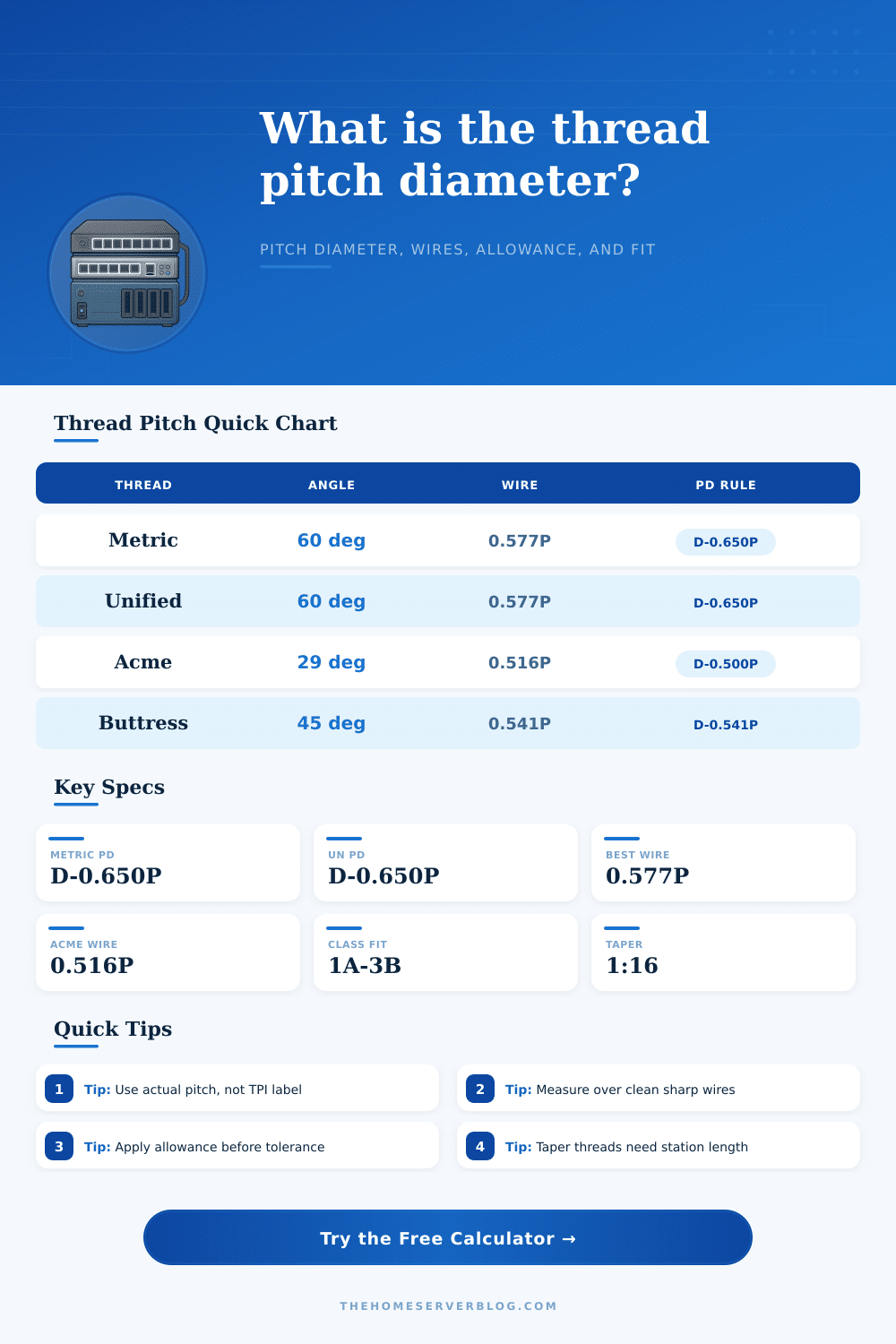
| ISO metric 60 degree | 60 degrees | D minus 0.649519 times pitch | 0.577350 times pitch |
| Unified UN 60 degree | 60 degrees | D minus 0.649519 times pitch | 0.577350 times pitch |
| NPT taper 60 degree | 60 degrees | Station major minus 0.649519 times pitch | 0.577350 times pitch |
| General Acme 29 degree | 29 degrees | D minus 0.500000 times pitch | 0.516450 times pitch |
| Buttress approximation | 45/7 degrees | D minus 0.541266 times pitch | 0.541266 times pitch |
| Fit choice | Typical use | Allowance direction | Inspection note |
|---|---|---|---|
| Free fit, 1A or 8g | Field assembly, plated parts | More external clearance | Good when dirt or coating is expected |
| Medium fit, 2A or 6g | General machine screws | Standard external allowance | Default for most shop calculations |
| Close fit, 3A or 4g6g | Precision studs and jigs | Small allowance | Needs better process control |
| Internal, 2B or 6H | Nuts and tapped holes | No external allowance | Check mating clearance separately |
| Common size | Pitch or TPI | Basic pitch diameter | Best wire |
|---|---|---|---|
| M6 x 1 | 1.000 mm | 5.350 mm | 0.577 mm |
| M10 x 1.5 | 1.500 mm | 9.026 mm | 0.866 mm |
| 1/4-20 UNC | 20 TPI | 0.2175 in | 0.0289 in |
| 3/8-24 UNF | 24 TPI | 0.3479 in | 0.0241 in |
| 1/2-13 UNC | 13 TPI | 0.4500 in | 0.0444 in |
| Measurement item | Formula | Use case | Caution |
|---|---|---|---|
| Pitch from TPI | 1 divided by TPI | Unified and NPT threads | Convert before mixing units |
| Three-wire reading | E + 3W - 0.866025P | 60 degree external threads | Approximate, no helix correction |
| Best wire 60 degree | 0.577350P | Standard V-thread inspection | Actual wires may differ |
| NPT taper | 0.0625 in per inch | Station diameter estimates | Use inspection plane length |
The pitch diameter is a critical measurements for any screw or bolt. The pitch diameter will ultimately determine how well the bolt will hold within the mating part. While the major diameter of the fastener may be the first that is measure, it is not the measurement that will determine how well the fastener will feel when being turn.
The pitch diameter is an imaginary cylinder locate where the two flanks of the threads meet at half of the flank angle. This parameter is critical in determining the clearance of the threads, the strength of those threads, and the amount of torque that can be applied to the bolt before the thread begin to strip. One of the issues that can be encountered with the pitch diameter is attempting to use a metric cap screw within an imperial hole, or attempting to reuse a part that was plated.
What Is Pitch Diameter and How to Measure It
The difference in diameter between a part that freely spins and one that binds after a few turns could be as small as a few thousandths of an inch in the pitch. Since the pitch diameter is a hidden measurement, specific inputs must be made within the calculator to determine the size of the pitch diameter. The choice of the type of thread (metric or unified) will determine the angle of the flank that is used in the calculation.
The choice of fit class will determine how much of the basic value of the pitch diameter is allowed before the thread tolerance is added to that value. Each of these choice will determine whether the thread is for an assembly jig, for a component that will experience dirt in the field, or for a component that will be plated. The three-wire method is used to determine the pitch diameter since the pitch diameter cannot be directly measured with calipers.
Wires is placed into the grooves of the thread, and the measurement over the wires is translated into the pitch diameter of the screw. The calculator will calculate the pitch diameter for you if you enter the actual size of the wires that you have on hand. While the theoretical best size of the wire will provide the most accurately reading for the pitch diameter, many facilities will use the nearest size of wire to what is stocked in the shop.
The difference in the measurement will be no more than a few ten-thousandths of an inch, but this small measurement will determine whether the parts pass inspection or whether they must be reworked. For threads that have a taper, such as NPT fittings, the pitch diameter measurement is more complex. NPT fittings has a change in diameter along the length of the screw or bolt.
For these threads, the pitch diameter must be measured at a specific station along the length of the thread. The engaged length of the threads will determine at what point the thread is being inspected, and it will also indicate whether the taper of the threads has shifted the measurement of the pitch diameter. For Acme and buttress threads, the calculation changes slightly because the angle of the flanks of the threads are different from common threads.
For these types of threads, the taper of the threads will change the factor associated with the best wire size to the pitch diameter, making the relationship between the major and pitch diameter of the screw easier to calculate. Allowance and tolerance are two different parameters for screw threads, but they are often confused with one another. The allowance for thread fit is used to make sure that the external threads will clear the internal threads of the mating part, even after those threads experience wear.
The tolerance is the amount of variation that is permitted around that allowance value. When the fit class of the screw or bolt is chosen, that choice will determine how much allowance and how much tolerance will be applied to the threads. A free fit allows for more allowance than a close fit.
The allowance will be increased for parts that are to be used in outdoor environment or for parts that are to be plated. A close fit allows for less allowance so that the parts will be able to maintain their position, and they will be measured for position on those component. The calculator will calculate the allowances and the tolerance for the threads, and this will allow the designer to make a decision about whether the process will be able to maintain those parameters.
A few of the mistake that people make in calculating the pitch diameter include mixing units, and failing to recognize that the pitch of a screw is the inverse of the number of threads per inch. Selecting twenty threads per inch for the pitch will result in an incorrect thread that will fail to assemble. Another mistake is using wires that are not clean and not round.
Any imperfection in the wire will result in a shift in the measurement of the pitch diameter that is more than the tolerance of that measurement. The engaged length of the threads is another parameter that is often neglected. For short threads, the error in the pitch diameter can be hidden from view.
For long threads, the error in the pitch diameter will be amplified. No matter how well the threads are manufactured, the real part will never match the ideal parameters for the threads as described in the mathematical equations. The variables of the threads will shift the pitch diameter of the threads slightly.
While the calculator will provide a good measurement for the pitch diameter, experienced quality control personnel will also check the parts on an optical comparator. The measurement from the calculator are a starting point for determining the thread parameters, and they will provide a way of comparing the different type of threads. However, the numbers are just a starting point for the inspectors to measure the parts, and the numbers are just a starting point for the tolerance to be establish.
When measuring threads, measure what you can reach and calculate the rest. Always verify the first few parts against the mating component, instead of just the drawing alone. This will allow you to catch any surprise before the parts are delivered to the customer.