Vertiv UPS Runtime Calculator
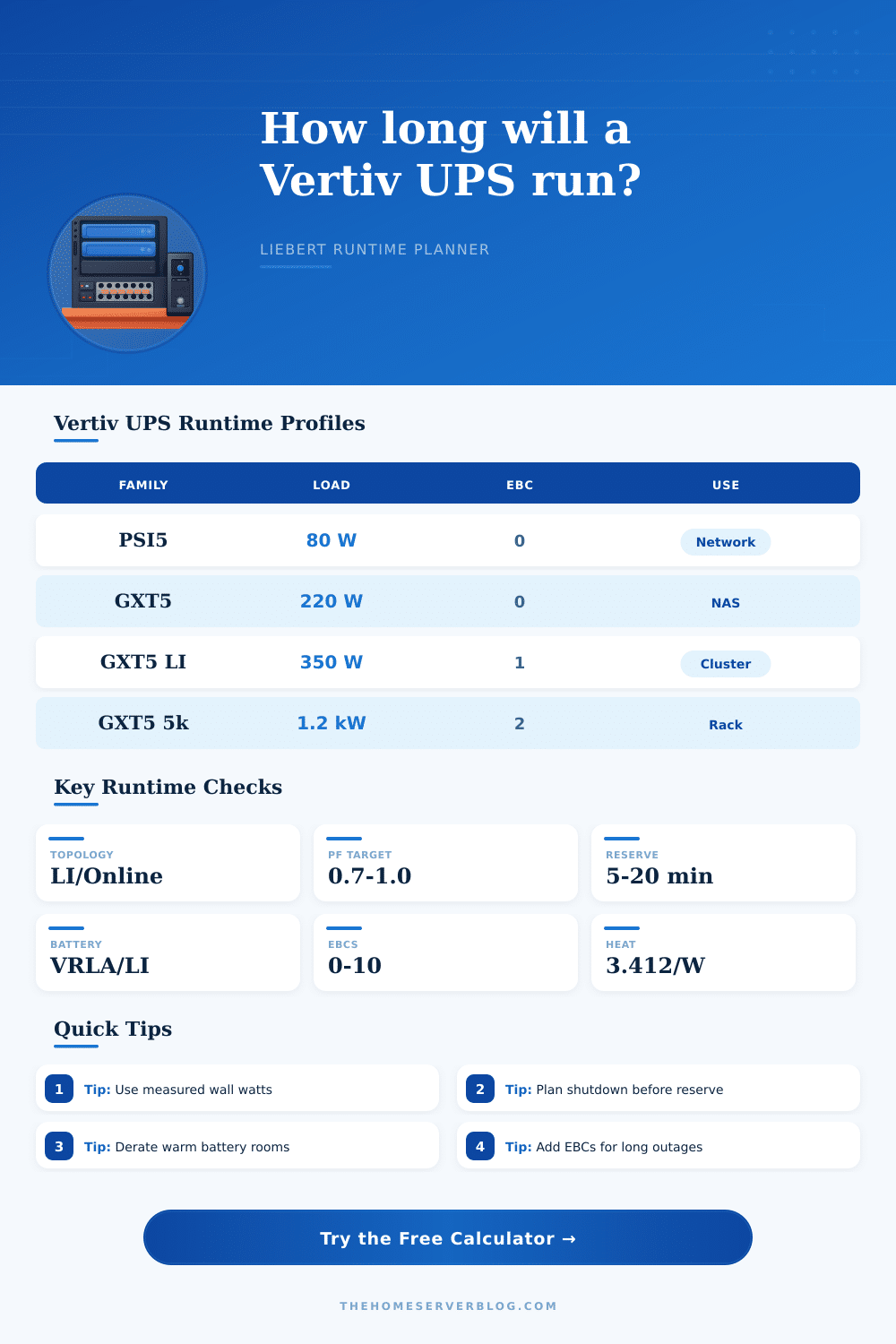
Estimate practical backup time for Vertiv Liebert UPS families by combining measured load, power factor, battery chemistry, external battery cabinets, aging, temperature, and shutdown reserve.
📌Vertiv home lab presets
⚙Runtime inputs
Online double-conversion profile with scalable runtime assumptions.
Use the wall-watt value shown by the UPS, PDU, or plug meter after the equipment has settled.
Modern active-PFC servers often sit around 0.90 to 0.98; mixed small adapters may be lower.
Use 0 for internal battery only. GXT5 families can be modeled with added matching cabinets.
Imperial uses degrees F. Metric mode shows the Celsius equivalent in results.
Use this to model shedding noncritical outlets before shutdown scripts finish.
📊Selected UPS spec grid
📘Vertiv family comparison table
| Family modeled | Topology profile | Typical home lab fit | Runtime note |
|---|
🔌Load planning table
| Equipment group | Typical load | PF range | Runtime planning advice |
|---|---|---|---|
| Fiber ONT, router, small switch | 25 to 60 W | 0.70 to 0.90 | A smaller PSI5 or Edge unit can provide long network continuity if PoE loads are excluded. |
| NAS with two to eight drives | 65 to 180 W | 0.85 to 0.98 | Reserve enough time for cache flush, array pause, and clean shutdown hooks. |
| PoE switch with APs and cameras | 120 to 420 W | 0.80 to 0.95 | Model actual PoE draw, not switch budget, then add a startup and night-IR buffer. |
| Mini PC virtualization cluster | 90 to 300 W | 0.90 to 0.99 | Runtime changes sharply with CPU load; measure during backup or migration activity. |
| Half rack with storage and core switching | 600 to 1800 W | 0.92 to 0.99 | Online GXT5 sizing is often driven by watts, VA, heat, and cabinet expandability. |
🧮Battery and derating table
| Derating item | Calculator treatment | Why it matters | Practical check |
|---|---|---|---|
| Battery health | Scales usable Wh directly | Runtime loss is usually visible before a battery fully fails. | Run a controlled self-test after replacing packs. |
| Battery age | Adds chemistry-specific capacity fade | VRLA packs commonly lose capacity faster than lithium packs in warm spaces. | Label install month on each internal pack or EBC. |
| Temperature | Penalizes hot battery rooms | Heat shortens life and reduces predictable reserve during outages. | Keep rack intake and UPS battery area ventilated. |
| External battery cabinets | Adds incremental Wh with taper | Each cabinet extends autonomy, but runtime gains are not perfectly linear. | Match cabinet family and firmware expectations. |
| Shutdown reserve | Subtracts minutes from output | Reserve prevents scripts from racing an exhausted battery. | Trigger automation before the reserve threshold. |
📋Common Vertiv sizing scenarios
| Scenario | Modeled UPS | Load range | Target runtime |
|---|---|---|---|
| Always-on internet stack | PSI5 or Edge 750 to 1500VA | 35 to 90 W | 60 to 180 minutes before reserve |
| Quiet NAS closet | GXT5 1000 to 1500VA | 100 to 240 W | 20 to 60 minutes with shutdown margin |
| PoE surveillance core | PSI5 1500 to 3000VA | 220 to 650 W | 15 to 45 minutes, often outlet-shed |
| Remote edge cabinet | GXT5 lithium-ion with EBC | 250 to 700 W | 45 to 180 minutes with monitoring |
| Half rack lab | GXT5 5kVA or 10kVA | 900 to 2800 W | 10 to 45 minutes plus clean shutdown |
💡Runtime planning tips
When you calculate the runtime of the batteries, you must consider the length of time that your equipment will be power on. Furthermore, you must also consider what will happen to the equipment in the minutes before the equipment shut down. These considerations is, therefore, the reasons why a Vertiv UPS sizing decision requires the use of a runtime calculator.
Each of the inputs for the runtime calculator will be used to calculate the length of time that the battery will remain powered on and the UPS will continue to provide power to the equipment. Thus, each of the variables are important to the runtime calculator to determine the length of time that the batteries will continue to provide power. The results of the runtime calculator will tell you if the UPS and batteries meets the goals that you have for the data center.
Why You Need a UPS Runtime Calculator
Furthermore, if there is not enough usable runtime with the current setup, you can use the calculator to determine whether adding battery cabinets will provide enough additional runtime to allow your servers to shut down gracefully, or whether you should reduce the load on the UPS. Additionally, high percentage for the load on the UPS will alert you to the fact that power spikes may damage your equipment. High temperatures will reduce the life of the batteries and the capacity of those batteries to supply power.
Thus, these outputs will allow you to plan the data center according to the actual capability of the batteries. The tables on the page provide information regarding the different UPS family that are available and that are commonly utilized in home lab data centers. The tables will allow you to understand the reason why some individuals choose line-interactive UPS units versus online double-conversion UPS units.
Additionally, the tables will allow you to understand how different wattages and power factors will impact the runtime of the UPS. Furthermore, the derating of the batteries after they have been sitting in warm data centers for long period of time will help you to understand why the batteries may fail prematurely. These tables are not a replacement for the runtime calculator, but they does assist in your understanding of the data center UPS units and variables.
Many individuals will size the UPS once and then never again. However, the equipment will change and the firmware of the UPS may change the way that the UPS draw power from the batteries. Additionally, the batteries will age over time and the failure of those batteries may not become apparent until after the power is lost.
Thus, the UPS and battery inputs will change, and you should use the runtime calculator to determine how these changes will impact the power provide to your data center equipment. The decision about what kind of UPS to buy will depend upon the goals that you have for your data center and the kind of equipment that will be within that data center. For instance, if you have goals of providing power to your servers during utility blips, you may not require a long runtime.
However, if you have storage hosts or virtualization hosts that will be turned off at the same time as your data center, you will need to provide enough runtime for those hosts to perform their shutdown procedure. Additionally, if you have PoE surveillance or remote edge data racks that the same UPS will power, you will need additional battery cabinets to provide enough runtime to allow those networks to shut down. Thus, there is no goal selection process, but the UPS will allow you to decide which goal is the more important for your data center.
One of the factors that will impact the batteries is the impact that temperature will have on the batteries. If the data center is ten degrees warmer than the battery rating, the batteries will provide less runtime to the data center; they will also fail more rapid. Additionally, ventilation for the batteries and the intake air for those batteries will have a major impact upon their performance.
Thus, this input will allow you to understand that the battery and data center room may have different temperatures. One of the factors that will impact the batteries is the type of chemistry of those batteries. For example, lithium-ion battery pack tend to age slower than VRLA battery packs.
Furthermore, the lithium-ion batteries can take deeper discharges without losing the same amount of capacity as the VRLA batteries. Thus, although VRLA batteries are an economical choice for those with home data centers, they will need to be replaced more often and their derating will occur at a higher rate than the lithium-ion batteries. You can select these two types of battery in the runtime calculator.
The value of the runtime calculator is in being able to see how different variables will impact the runtime of the batteries before you purchase any UPS or battery products. In the event that there is a power outage and the power returns, you can determine if your data center powered down graceful or if it experienced a hard stop in the functions of the data center. Thus, the value of the runtime calculator is in giving you the ability to plan the data center according to the actual variable and factors of your data center.